Invoice Specification
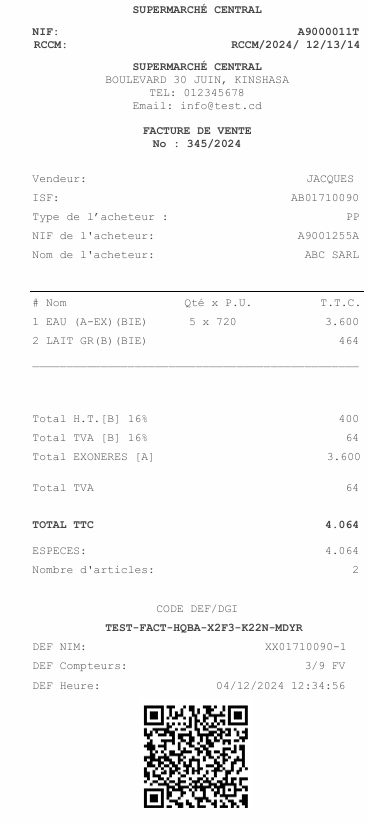
Although the visual format is flexible, the detailed content below is mandatory. This section outlines the minimum set of required information.
This technical documentation details the mandatory elements that must appear on invoices printed by the Business Invoicing System (SFE) to comply with the directives of the General Tax Directorate (DGI). Download: Protocoles_SFE-MCF_v1.0.pdf
Taxpayer Information (Seller)
The invoice header must clearly identify the issuing company. The mandatory fields are:
- The company name or denomination.
- The Tax Identification Number (NIF).
- The Trade and Movable Credit Register (RCCM) number.
- The physical address.
- Contact details, including email and phone number (Optional).
Customer Information (Buyer)
This information is only included if the customer has specifically requested that their data appear on the invoice. If so, the invoice must display:
- The customer type. Here are the types recognized by the DGI:
- PP Natural Person;
- PM Legal Entity;
- PC Commercial Natural Person;
- PL Liberal Profession;
- AO Embassy and International Organization;
- The customer's NIF.
- Optional if the customer type is AO (Embassy and International Organization) and PP (Natural Person)
- The full name or company name;
- The address and contact information;
- The RCCM number (Optional).
Invoice and Operator References
The SFE must print the transaction and system identification information:
- Invoice Type and Internal Number: The type of invoice accompanied by the internal invoice number generated by the SFE.
- Special Mentions:
- If it is a copy, the mention DUPLICATE is mandatory.
- If it is a credit note, the mention CREDIT NOTE must appear with the reference number of the initial invoice.
- If it is an export, the mention EXPORT INVOICE is required.
- If it is a down payment, the mention DEPOSIT INVOICE must be added.
- Operator: The name or identifier of the seller/operator performing the transaction.
- ISF: The identifier of the SFE that registered the invoice.
Item Details (Body of the invoice)
For each item or service invoiced, the corresponding line must include:
- The item name, quantity, unit price, and the total amount for that line.
- Taxation label: A mention specifying the tax group (e.g., (A-EX) for an exempt item, (B) for an item subject to VAT).
- Item type: A mention indicating the nature of the item
- BIE for goods.
- SER for services.
- TAX for taxes.
- Specific Tax: If a specific tax applies to an item, an additional line named "T.S." must be printed under the item, specifying the value of this tax (as a fixed amount or percentage).
Financial Summary (Totals)
The bottom part of the invoice must summarize the amounts in a detailed manner:
- Sub-totals Excluding Taxes (Excl. Tax): The total Excl. Tax must be displayed for each tax group, provided that this value is not zero.
- VAT Sub-totals: The total VAT for each tax group (if applicable) must be displayed, if the value is not zero.
- Total VAT: The cumulative amount of VAT for the entire invoice.
- TOTAL Incl. Tax: The overall amount Including All Taxes.
- Payment: The payment method(s) used (e.g., Cash, Bank Transfer).
- Total quantity: The total number of items on the invoice.
Security Elements
The invoice is only standardized if it includes the security elements returned by the Fiscalis API. The SFE must print:
- DEF/DGI CODE: Corresponds to the invoice identifier on the DGI servers. This code is unique and has 24 characters.
- NIM: Corresponds to the identifier of the machine that carried out the transaction.
- Counters: This is the counter of the NIM.
- Date Time: Corresponds to the time of the invoice standardization.
- QR Code: Corresponds to the QR code of the invoice.